Wednesday, 26 August 2015

Sign of the Times: Music and Design, 1960s-1980s - Cooper Hewitt design lecture.

Cooper–Hewitt, Smithsonian Design Museum, is one of the most respected design museum's housing some of the most important pieces of design history. It regularly posts videos of design lectures held in New York and this one seemed relevant to where I want to go with my dissertation.  Below are a type up of my notes from said lecture.

Art, Design, Music & Pop Culture have always had a crossover. Members of The Rolling Stones, The Beatles and The Who all went to Art college. Charlie Watts before the band even started in 1955 was a graphic designer by trade. One of the first designers that these art students would of been interested in was Saul Bass. His title sequences were essentially abstract art set to music.


Going back a little further in the late 40's/early 50's, modernism was banned or rejected by music, the fashion of the teddy boys was Edwardian in style. This in the late 50's this all changed with the influence of pop art. Former teddy boys, the Beatles took pop art to a whole new level with Sgt Pepper's Lonely Hearts Club band. A £3000 album cover that put Sir Peter Blake in the public consciousness. A regular album at the time on average cost around £50. Another big pop art & more importantly Post modern album cover is the debut by the work of the Velvet Underground & Nico. The front cover is a banana against a white background and signed by Andy Warhol. It took the vernacular (the everyday) and appropriated it to give it a different meaning.


Milton Glaser's, the founder of Push Pin, famous poster for Bob Dylan's Greatest hits we may think is a psychedelic masterpiece but it directly references the style of art nouveau a style famous from 1890 until the First World War. Psychedelic posters at the time were all very reminiscent of Art Nouveau. Victorian imagery, curvilinear calligraphy & finesse all very characteristic.


Designs done by Paula Scher appropriated design styles dependent on theme per LP for her design career at CBS records. With a hatred of Helvetica, use of a swiss style was unlikely to be adopted. Hand lettering, finesse and constructivism, anything but helvetica. Borrowed from the past is the way she describes it in her part of the lecture.


the last speaker spoke on the subject of Punk Rock and praised the anyone can do it attitude. Despite it being different in tone across the globe, there is a universal style in the fanzines that followed each of the scenes; cheap & anti professionalism, despite the methods of communication that they used being nothing new. Collage, the main theme throughout the fanzines, had been around for a long time prior to the birth of punk. An explanation that designing for punks signed to major labels would be harder; making an anti establishment design for a corporate product.


https://www.youtube.com/watch?v=OSasiEgUSy4

Tuesday, 25 August 2015

Peter Saville

I am trying to view this without a a sense of bias as he is one of the very reasons that I am in the field of Graphic Design. His anthology of design for Factory Records was my bible prior to coming to uni.

Peter Saville is a graphic designer from Manchester. Even from his outset his ideals of post modernism were highly evident. His first piece for The Factory - re-appropriated a warning sign on a building site to a gig poster. Later on in his work for Joy division, he contextualized a science diagram for one of the most iconic albums of the punk era. New Order was the band, he did the most work for and a lot of that work has since been discovered to be re-appropriated. He has made no secret about this; "Better to quote... than to Parody ...it is more honest, more intellectual" from No More Rules: graphic design + post modernism.

On the left hand side is the original material, pre-appropriation by Peter Saville and on the right is the LP/Record cover.


Tuesday, 4 August 2015

Postmodernity vs. the Postmodern vs. Postmodernism

Georgetown university, in Washington DC has online faculty page on "Po-Mo". It discusses Postmodernity, the Postmodern & Postmodernism in sections. It approaches different aspects of all of these from many different angles.

It defines Post Modernism, as a mix of low (pop) and high culture. The Pop culture element comes from what the majority of the population enjoy (Pop music, the Sun, take away meals) and the high culture comes from what the top percent of the population enjoy (Classical music, Financial times & michelin star restaurants). It tells that designers, at the time, took the decision to reject the modernist values and it's master narrative ideas.
It was a remix trend. It took existing material and re-purposed it; old photos of the stars (seen as low culture) were given a new colour scheme and hung on the gallery wall (high Culture).  Whaam by Roy Lichtenstein references directly action comics of the 1950s (low Culture) and turn it into art (High Culture).


Directly linked to this remix idea, is connected to the idea that the history is not the authority of the current, more a source in order to pastiche, collage and parody. It's purpose; nostalgic or otherwise. In the 21st century, it is a given that everything is post modern & the influence of all of the current trends are already mixed sources, thus making everything and anything post modern.

V&A

in 2012, the victoria and albert musem did an exhibition on post modernism entitled; Postmodernism: Style & Subversion 1970–1990. It explored what they determined to be the cream of the crop of post modern design in a lot of fields but sadly missed out Graphic Design. However reading the exhibition preface it has some useful explanations of the terminology and themes behind the movement.

As a movement it shattered the ideas of the past throwing away the conventional and exaggerated on it. To make it more then just a functional piece of design. It was a piece that actually had style, a statement piece.

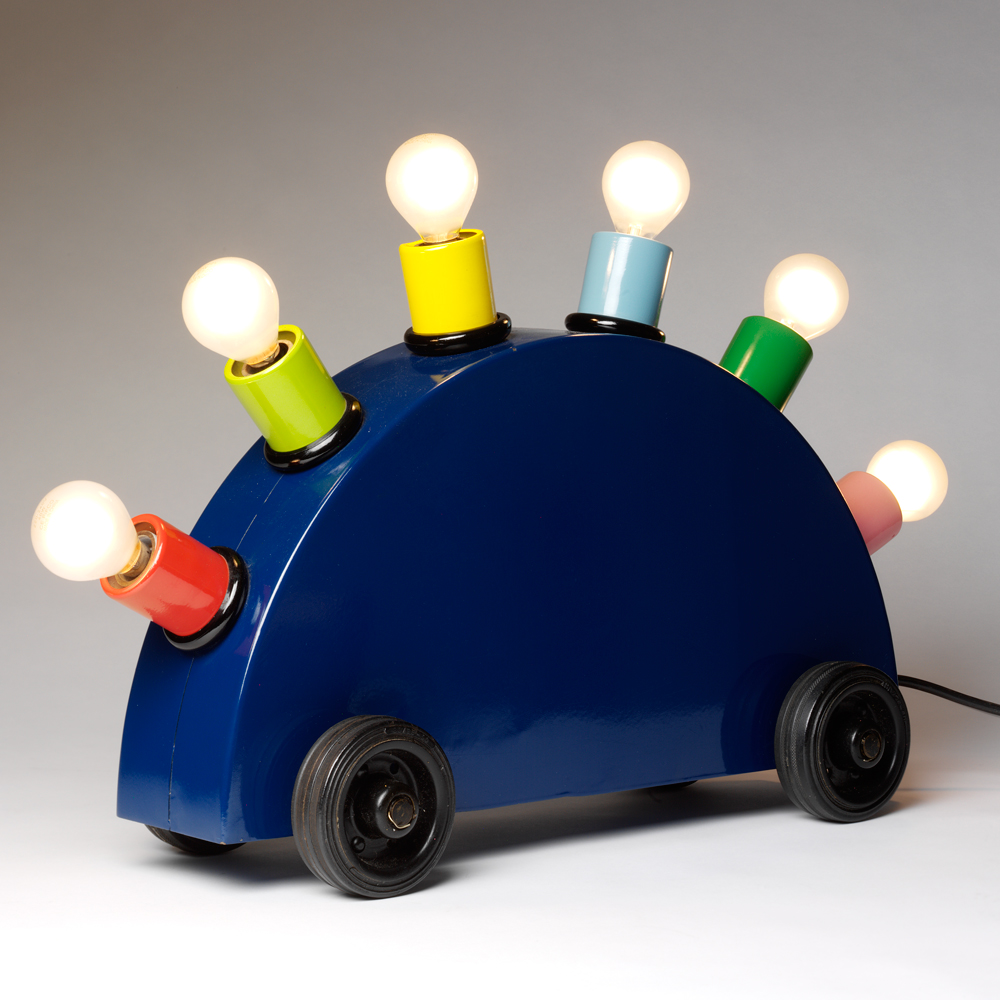
Martine Bedin (for Memphis), Super lamp prototype, 1981. Painted metal with lighting components. V&A: M.1-2011
Post modernism was often controversial, and sometimes over stepped the line of taste.  Even sometimes being so obvious and so self congratulating that it is visually painful.Being self aware of the design decisions that they are making was used to create a sense of irony. This irony and self congratulation became very unstable as it would get very tiresome.

A theme of a lot of post modern is exaggeration. in size, in colours & done sometimes for parody. Now below you can see Mr David Byrne (of Talking Heads fame(left)) in the famous Stop Making Sense suit. It is seen my many to be a  big piece of post modern design because it is exaggerated in size and may very well of been a parody of the 9 to 5 office workers outfit. Grace Jones' dress on the right is also considered a masterpiece of post modern design; it is big, bright and comedic in it's sheer styling. It ticks all of the boxes and is self aware it is doing all of these things.

The ever successful rise of post modernism would lead to its decline. It started as a design revolution mainly over the early 1980's but by the end of the 80s it had become commercialized. It just crippled under the weight of it's own success. It can still be felt in the undertones of current design and it's subsequent trends.

Monday, 3 August 2015

Post modernism - Short definitions

Britannica -   a western philosophy built around the skepticism of the modernist movement

PBS -  a wide ranging term applied to literature, art, philosophy, architecture, fiction & culture.

Guardian - Fun, Bright and Clever but disposable and sometimes rather disturbing. Nothing is new , nothing is direct. 

Definitions

Post Modernism - Conscious use of earlier styles or conventions
Parody - Imitation for comedy
Tribute - Intended to Gratitude, Respect or Admiration
Homage - honour or respect
Vernacular - Common Place, Taken for granted

Record Cover - Outer Covering of an album
Album - a collection of recordings issued as a single item on CD, LP or alt medium.
Spotify - Commercial Streaming service
Streaming - Playing via the internet without owning the material
iTunes - Store for digital music & video
Download - copying data from the internet to a computer